

The Hidden Cost of Domain Mismatches in Outbound Mail
Failing to configure DMARC alignment means major inbox providers will silently drop or quarantine legitimate system alerts, transactional emails, and newsletters. Having technically valid SPF and DKIM records is insufficient if the domains authenticated by those protocols fail to match the domain visible to the end user. This misconfiguration is a common reason self-hosted relays and third-party SMTP services experience sudden deliverability drops when administrators enforce strict DMARC policies.
Administrators often assume that passing an SPF check ensures inbox placement. Modern email infrastructure demands strict alignment between the authenticated sender and the visible sender. When a local server generates an alert, the cron daemon typically constructs the email using the local system user and the machine's hostname. This results in an envelope sender address that reflects the internal network rather than the public-facing domain.
Diagnostic Focus Shift
During the initial audit of dropped cron job alerts, the troubleshooting focus shifted from verifying DNS syntax to analyzing domain mismatches in the email headers.
Major inbox providers silently quarantined system alerts generated by local cron jobs due to a mismatch between the local hostname and the public domain. The initial audit of dropped transactional emails spanned several weeks. The technical approach required mapping the routing path of these alerts to identify the node where the domain divergence occurred.
Bridging the Gap Between Authentication and Header Domains
Email architecture relies on two distinct 'From' addresses, a design choice that frequently complicates authentication troubleshooting. The RFC 5321 MailFrom acts as the Return-Path or Envelope From, dictating where receiving servers send bounce messages. The RFC 5322 From serves as the Header From, which is the address displayed in the recipient's email client. DMARC acts as the bridge between these two addresses, requiring either the SPF-authenticated domain or the DKIM-authenticated domain to align with the RFC 5322 Header From domain.
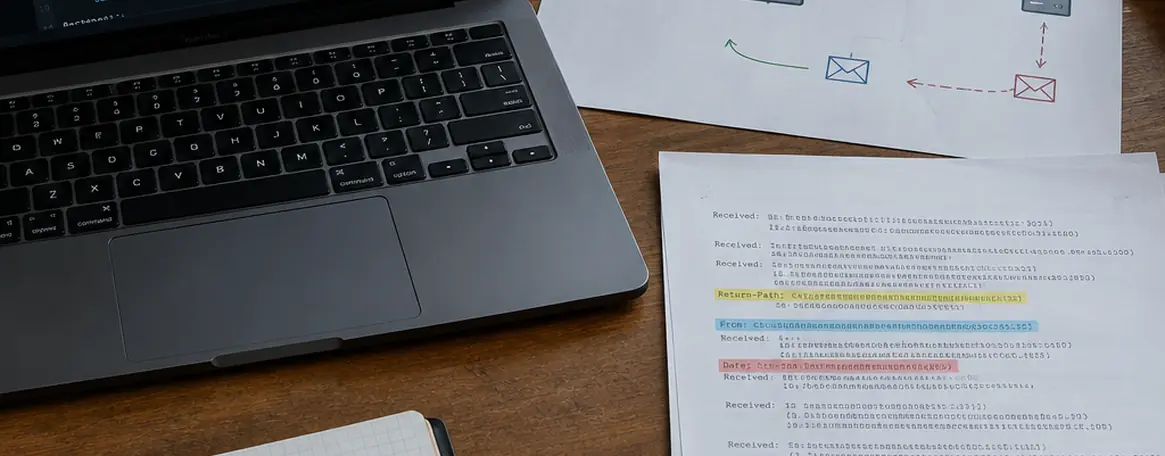
To isolate the root cause of the deliverability drop, the administration team extracted and compared the RFC 5321 MailFrom and RFC 5322 From headers across all outbound mail streams. The analysis required parsing the raw email headers to locate the exact Return-Path and Header From values. Extracting these headers requires analyzing the raw MIME source of the message, as the final receiving Mail Transfer Agent stamps the Return-Path at the top of the message during delivery.
The infrastructure team conducted log aggregation and header comparison over a period of 48 to 72 hours. Reviewing the RFC 7489 specification clarifies that email authentication verifies the sender's IP or cryptographic key, whereas DMARC alignment verifies domain consistency. A message can authenticate its origin IP through SPF yet fail DMARC because the domain evaluated during the SPF check differs from the domain the end user sees.
Why Third-Party Relays Break Envelope Sender Alignment
Receiving servers evaluate SPF alignment strictly against the Return-Path domain. Third-party senders like Amazon SES or Mailgun default to using their own domains in the Return-Path to handle bounce processing automatically. This default behavior results in a passing SPF authentication check because the sending IP is authorized for the provider's domain. The SPF alignment check fails because the provider's domain diverges from the sender's Header From domain.
Initially, the deployment team considered enforcing strict SPF alignment to resolve these discrepancies. The team discarded this approach because it immediately caused authentication failures for legitimate subdomain traffic, leading to the adoption of relaxed alignment instead. Relaxed alignment permits a subdomain in the Return-Path to align with the organizational root domain in the Header From.
The deployment team configured the SPF record with the aspf=r tag to allow organizational domain matching for third-party SMTP relays. DNS propagation for the updated SPF alignment tags was recorded around 12 to 24 hours. Strict alignment would reject this configuration, demanding an exact character-for-character match between the two domains.
Securing Cryptographic Signatures at the Edge
Receiving servers evaluate DKIM alignment by comparing the d= tag in the DKIM signature header against the RFC 5322 Header From domain. A single message can carry multiple DKIM signatures as it traverses different routing nodes. DMARC only requires one aligned signature to pass the evaluation.
When configuring the edge relays, the administration team chose to generate local 2048-bit RSA keys for DKIM signing rather than relying on a centralized upstream gateway, ensuring signatures remained intact before leaving the local network. Generating keys locally prevents scenarios where internal network modifications invalidate a signature before the message reaches the public internet. The DKIM configuration used 2048-bit RSA cryptographic keys specified in the d= tag of the signature header.
Cryptographic Key Management
Delegating DKIM signing authority to self-hosted edge relays introduces the operational challenge of key management across distributed nodes.
The infrastructure team established a strict key rotation schedule, requiring new cryptographic pairs to be generated every 60 to 90 days. The d= tag must explicitly match the Header From domain to achieve DKIM alignment, making the placement of the signing authority a critical architectural decision for self-hosted environments.
Configuring Postfix for Custom Bounce Subdomains
Fixing SPF alignment requires an architectural solution: configuring a custom MAIL FROM domain, such as a dedicated bounce subdomain, in services like Amazon SES. The DNS requirements for this setup include publishing an MX record and a specific SPF record for the custom bounce subdomain. This configuration ensures that bounce messages route correctly while maintaining domain alignment with the Header From address.
Implementing a custom bounce subdomain requires that the underlying DNS infrastructure supports assigning dedicated MX records directly to subdomains, restricting this setup on basic registrars that only allow root-level mail routing.
The deployment strategy for the custom MAIL FROM involved modifying the Postfix main.cf file to ensure internal routing mechanisms did not overwrite the envelope sender address. Preserving the envelope sender through internal relays prevents the local Mail Transfer Agent from appending the internal hostname to the Return-Path. The Postfix configuration required setting sender_canonical_classes = envelope_sender to preserve the original Return-Path.
Testing the new relay configuration and verifying the Authentication-Results headers was recorded around 15 to 30 minutes per server node. Restricting the canonical classes ensures that the system only rewrites the intended addresses, preserving the alignment established by the application layer.
Cryptographic Survival Across Auto-Forwarding Topologies
Auto-forwarding mechanisms inherently rewrite the Return-Path to direct bounces back to the forwarder. This necessary routing modification permanently breaks SPF alignment in transit. Because SPF alignment cannot survive forwarding, a valid, aligned DKIM signature is the only authentication method that can preserve DMARC compliance across complex email routing topologies.
Transit Authentication Failures
Relying solely on SPF for DMARC alignment creates a fragile infrastructure that fails when a user configures a mailbox to forward messages to a secondary address.
After observing consistent SPF alignment failures during auto-forwarding, the deployment strategy shifted to require DKIM signatures on all outbound messages to preserve DMARC compliance. The administration team parsed DMARC aggregate reports to identify instances where the Authentication-Results header showed spf=fail alongside dkim=pass during transit. That combination confirms that the message survived forwarding solely because of the DKIM signature.














Leave a Comment