
From TCP Bottlenecks and Deflate to QUIC and Dictionary Compression
Modern web optimization frequently hits a ceiling imposed by foundational 1990s protocols. For decades, server administration relied on RFC 1952 (Gzip/Deflate) for payload reduction and TCP for reliable transport. Although HTTP/2 introduced stream multiplexing over a single TCP connection, it remained vulnerable to transport-layer head-of-line blocking. When a single packet drops on a lossy wireless link, the operating system kernel holds back all multiplexed HTTP/2 streams until the missing TCP segment is retransmitted and acknowledged.
Two distinct engineering milestones resolved these transport and compression bottlenecks. First, the IETF published the Brotli specification in July 2016 under RFC 7932. Brotli replaces Gzip's limited 32 KiB sliding window with a maximum sliding window of 16 MiB. It also incorporates a pre-defined static dictionary of 122,784 bytes containing 13,504 common words, phrases, and HTML/JavaScript tokens. Second, transport architecture shifted away from TCP entirely. Following the standardization of QUIC in RFC 9000 in May 2021 and HTTP/3 in RFC 9114 in June 2022, stream multiplexing moved over to UDP. Because QUIC handles stream framing and loss recovery independently within user space, a dropped UDP datagram only stalls the specific asset stream associated with that packet.
Bringing these protocols into self-hosting & homelab environments requires specific upstream software revisions. Experimental HTTP/3 support entered the Nginx 1.25.0 mainline branch in May 2023. While upgrading our reverse proxy tier, we evaluated linking against BoringSSL or the QuicTLS fork before deciding to standardize on native OpenSSL 3.2+ packages alongside the Nginx 1.25.0+ mainline branch to simplify long-term security patching. Operators must note that kernel-bypass UDP optimizations yield minimal throughput gains on low-concurrency internal networks, making this stack most effective for public-facing edge nodes serving remote clients.
Evaluating CPU Overhead, TLS 1.3 Mandates, and UDP Firewall States
Deploying modern compression and UDP transport changes how a LEMP stack consumes compute and network resources. Setting brotli_comp_level 11 on dynamic responses can saturate Cortex-A72 cores for hundreds of milliseconds per response, starving nginx worker processes during concurrent TLS 1.3 handshakes. Compressing the same payload dynamically at level 4 can complete much faster.
To protect edge CPU capacity on ARM64 nodes, we ruled out maximum-effort dynamic compression for live PHP-FPM responses. Instead, we settled on dynamic level 4 for generated HTML alongside automated CI/CD pre-compression at level 11 for static assets via brotli_static on. This hybrid model preserves worker thread responsiveness while delivering maximum byte reduction on immutable scripts and stylesheets.

At the cryptographic layer, QUIC embeds TLS 1.3 directly into its handshake frames, eliminating separate TCP and TLS round trips and enabling 0-RTT connection resumption. Server configurations must enforce strict TLS 1.3 cipher suites; attempting to negotiate HTTP/3 over legacy TLS 1.2 parameters will cause protocol initialization to fail immediately.
Network middleboxes present the final architectural hurdle. Enterprise firewalls and residential routers frequently apply aggressive stateful inspection to UDP traffic, dropping UDP port 443 datagrams after a 30-to-60-second idle timeout or causing NAT rebinding failures. While the standard Alt-Svc header example advertises an 86,400-second (24-hour) cache window, deploying a shorter ma (max-age) parameter of 300 to 900 seconds during initial rollout prevents prolonged client blackholing if a local firewall silently drops UDP packets, allowing browsers to fall back cleanly to HTTP/2 over TCP.
Socket Reuseport Virtual Host Limits
The
listen 443 quic reuseportdirective must appear exactly once per IP/port socket across the entire Nginx configuration tree, whereas secondary virtual hosts on the same address must declare onlylisten 443 quic. Duplicating thereuseportparameter across multiple server blocks triggers annginx: [emerg] duplicate listen optionsstartup failure.
Compiling Modules and Declaring QUIC Listeners in nginx.conf
Because standard distribution repositories often omit the third-party Google Brotli module, deploying both protocols simultaneously typically requires compiling Nginx from source or building dynamic modules against matching mainline headers. Compiling the ngx_brotli module alongside the --with-http_v3_module flag on a 4-core self-hosted build node can take several minutes from git submodule initialization to binary installation.
Step 1: Verify Build Arguments and Module Dependencies
Before modifying configuration files, inspect the compiled Nginx binary using nginx -V to verify that both HTTP/3 and Brotli modules are linked properly:
$ nginx -V 2>&1 | grep -o -E 'http_v3_module|ngx_brotli'
http_v3_module
ngx_brotli
Ensure your host firewall permits incoming UDP datagrams on port 443. On modern Linux distributions utilizing nftables, add an explicit acceptance rule for udp dport 443 alongside your existing TCP rules.
Step 2: Configure Brotli Directives in the HTTP Block
When structuring the nginx.conf transport directives, configure explicit MIME-type whitelisting for text, styles, scripts, and WebAssembly while omitting binary formats like JPEG, PNG, and WOFF2 to prevent wasted CPU cycles on already-compressed payloads.
http {
    brotli on;
    brotli_comp_level 6;
    brotli_static on;
    brotli_types
        text/plain
        text/css
        application/javascript
        application/json
        image/svg+xml
        application/wasm;
}
Step 3: Declare QUIC Listeners and Alt-Svc Headers
Inside your primary virtual host configuration, declare both the UDP QUIC listener and the standard TCP SSL listener. Reference the Nginx ngx_http_v3_module official documentation for complete directive context when tuning transport buffers.
server {
    listen 443 quic reuseport;
    listen 443 ssl;
    server_name example.com;

    http2 on;
    http3 on;
    quic_retry on;

    ssl_protocols TLSv1.3;
    ssl_certificate /etc/letsencrypt/live/example.com/fullchain.pem;
    ssl_certificate_key /etc/letsencrypt/live/example.com/privkey.pem;

    add_header Alt-Svc 'h3=":443"; ma=86400' always;

    location /assets/ {
        add_header Alt-Svc 'h3=":443"; ma=86400' always;
        add_header Cache-Control "public, max-age=31536000, immutable";
    }
}
Configuring quic_retry on validates client source IP addresses using cryptographic retry tokens to mitigate UDP amplification attacks. Notice that the Alt-Svc header is repeated inside the /assets/ location block; in Nginx, declaring any add_header directive inside a child location overrides all parent block headers unless explicitly redeclared.
Validating QUIC Handshakes and Payload Reductions via CLI and Telemetry
To confirm end-to-end protocol negotiation without relying on cached browser state, compile or install a curl binary linked against nghttp3 and ngtcp2. Run two distinct requests from an external host to verify both UDP transport negotiation and Brotli content encoding:
$ curl --http3-only -I https://example.com
HTTP/3 200
server: nginx/1.25.4
content-type: text/html; charset=UTF-8
alt-svc: h3=":443"; ma=86400

$ curl -H "Accept-Encoding: br" -I https://example.com/assets/app.js
HTTP/2 200
server: nginx/1.25.4
content-type: application/javascript
content-encoding: br
cache-control: public, max-age=31536000, immutable
For browser-based validation, open the Chromium DevTools Network tab, right-click the table header to enable the Protocol column, and reload the page twice. The initial load negotiates over HTTP/2 and parses the Alt-Svc header, while subsequent requests display h3. Comparing the Size column (transferred network bytes) against the Resource Size column (uncompressed bytes) confirms active Brotli decompression.
On the server side, append the $http3 variable to your custom log_format directive in nginx.conf. In Nginx access logs, the variable outputs h3 for standard HTTP/3 requests and hq for HTTP/0.9 over QUIC fallbacks, while tcpdump -ni eth0 udp port 443 captures handshake traffic. Over an emulated lossy link configured via Linux tc netem with 150 ms delay and 2% packet loss, transferring a pre-compressed .js.br asset over UDP port 443 can avoid the transport-layer stalls that affect parallel HTTP/2 streams during TCP retransmission.
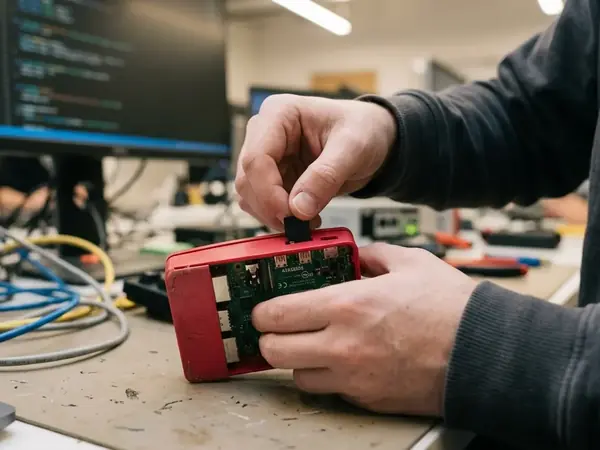
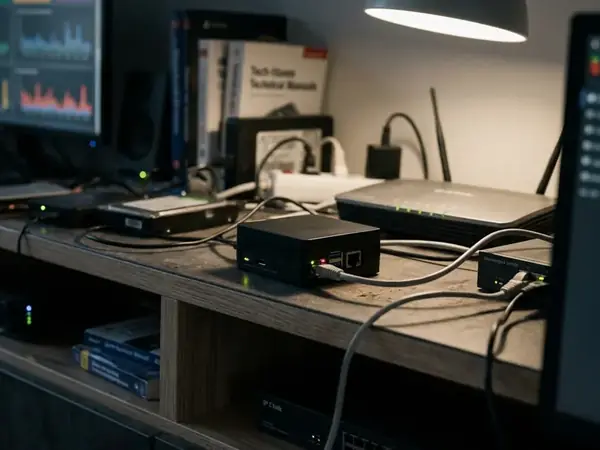
During a maintenance window, the glow of a dual-monitor Linux workstation illuminates a quiet office. On the left screen, a live tcpdump -ni eth0 udp port 443 session streams raw packet headers from a self-hosted Raspberry Pi 4 cluster sitting on the local rack. On the right screen, a remote test harness triggers a simulated 3G mobile client over the tc netem interface. As the client requests a pre-compressed 450 KB JavaScript bundle, UDP datagrams scroll through the terminal. With packet loss set to 2%, the Nginx access log prints an h3 200 OK status as the script finishes loading on the client.










Leave a Comment